LGBTQ+ Video Game Representation Infographic

Created by Dr. Adrienne Shaw (Temple University) in Fall 2024, this Infographic is intended to provide a basic summary of commonly asked information from the LGBTQ Game Archive as well as some historical context (although please refer to our “about” page for all caveats). There are citations for everything included at the end, and downloadable PDF versions of the full infographic and one broken into smaller sections available for teaching purposes and if the below images are less clear on the screen you are using.

  • Infographic on LGBTQ+ video game representation. Highlights a 400% increase in LGBTQ+ content, with most representation in characters. Shows less than 30% are playable. Representation often implied rather than explicit." Designed by Adrienne Shaw, LGBTQ+ Game Archive.
  • Timeline infographic titled "History of LGBTQ+ Video Game Representation." Sections include LGBTQ+ political and gaming history, notable LGBTQ+ game protagonists, and same-sex relationship options. Key events span 1985-1989, noting organizations like GLAAD and ACTUP, and games with LGBTQ+ characters. Informative and historical tone. Designed by Adrienne Shaw, LGBTQ+ Game Archive.
  • An infographic titled "History of LGBTQ+ Video Game Representation" features a timeline from 1990 to 1995. It highlights key events: the term "gaymer" in 1990, "Ultima IV" game in 1991, Lesbian Avengers founded in 1992, the game "Gay Blade" in 1993, "Don't Ask, Don't Tell" policy in 1993, and "Orion Conspiracy" in 1995. Sections are color-coded, detailing political history and gaming milestones. Designed by Adrienne Shaw, LGBTQ+ Game Archive.
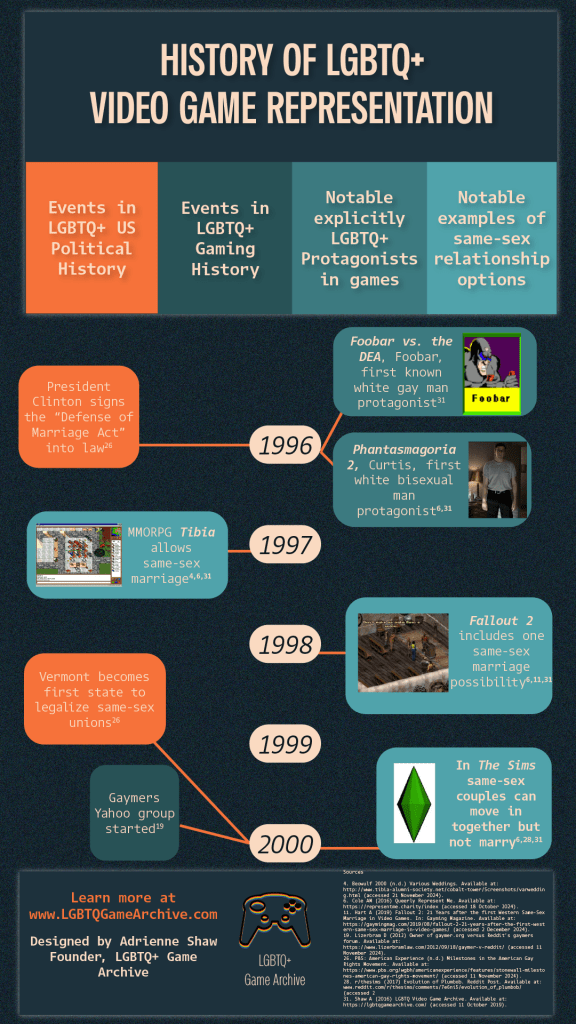
  • Infographic titled "History of LGBTQ+ Video Game Representation." It highlights events from 1996-2000, such as political milestones and LGBTQ+ gaming history, featuring games like "Phantasmagoria 2" and "The Sims." The timeline shows intersections between political events, game releases, and LGBTQ+ representation. Designed by Adrienne Shaw, LGBTQ+ Game Archive.
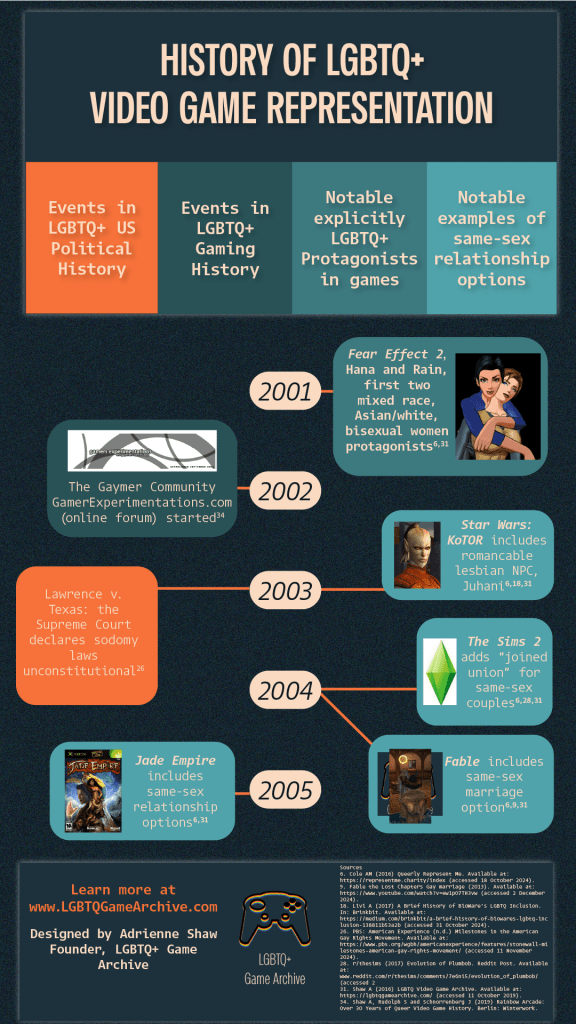
  • Infographic titled "History of LGBTQ+ Video Game Representation" shows a timeline from 2001 to 2005. It highlights milestones in LGBTQ+ US political history, gaming history, and video game representation, such as mixed-race bisexual protagonists in "Fear Effect 2" (2001), and same-sex marriage options in "Fable" (2005). Also noted are Lawrence v. Texas (2003) and the launch of GamerExperimentations.com (2002). Tone is informative and celebratory. Designed by Adrienne Shaw, LGBTQ+ Game Archive.
  • Infographic titled 'History of LGBTQ+ Video Game Representation'. It divides events into categories: LGBTQ+ US political history, LGBTQ+ gaming, LGBTQ+ protagonists, and same-sex relationship options. Timeline spans 2006 to 2010, highlighting events like the start of Gay Gaming Professionals, MTV's 'gaymer' segment, CA Prop 8 passage, and games like 'Fable 2', 'The Sims 3', and 'Dragon Age: Origins'. Designed by Adrienne Shaw, LGBTQ+ Game Archive.
  • Infographic titled 'History of LGBTQ+ Video Game Representation' shows a timeline from 2011 to 2015. It highlights key events in LGBTQ+ political history, gaming milestones, notable LGBTQ+ protagonists, and same-sex relationship options in games. Examples include 'Dys4ia' and 'Mainichi' in 2011 and 'Dreamfall: Chapters' in 2015. Designed by Adrienne Shaw, LGBTQ+ Game Archive.
  • Timeline detailing LGBTQ+ video game representation from 2016 to 2020. Includes key political and gaming events, such as anti-LGBTQ legislation, GLAAD initiatives, and games like "Dream Daddy" and "Tell Me Why." Displays an infographic layout with colorful sections for each year and topic. Designed by Adrienne Shaw, LGBTQ+ Game Archive.
  • Infographic titled 'History of LGBTQ+ Video Game Representation.' It features four categories: US political events, gaming events, LGBTQ+ protagonists, and same-sex relationships in games from 2021 to 2024. Notable mentions include the Gayming Awards, 'Life is Strange: True Colors,' 'The Sims 4,' 'Baldur's Gate 3,' and 'Dragon Age: Veilguard.' Political context notes the Respect for Marriage Act and increasing anti-LGBTQ bills by 2024. A timeline layout with images and icons conveys a sense of expansion in representation and recognition. Designed by Adrienne Shaw, LGBTQ+ Game Archive.
  • Infographic titled '% of Games with LGBTQ+ Representation' featuring three claw machines. Left to right: 1.08% for 2010s games, 0.5% on itch.io as of October 2022, 2.5% on Steam as of November 2023. Designed by Adrienne Shaw, LGBTQ+ Game Archive. Dark background conveys a serious tone."
Introduction: Infographic on LGBTQ+ video game representation. Highlights a 400% increase in LGBTQ+ content, with most representation in characters. Shows less than 30% are playable. Representation often implied rather than explicit." Designed by Adrienne Shaw, LGBTQ+ Game Archive.

1980s: Timeline infographic titled "History of LGBTQ+ Video Game Representation." Sections include LGBTQ+ political and gaming history, notable LGBTQ+ game protagonists, and same-sex relationship options. Key events span 1985-1989, noting organizations like GLAAD and ACTUP, and games with LGBTQ+ characters. Informative and historical tone. Designed by Adrienne Shaw, LGBTQ+ Game Archive.

1990-1995: An infographic titled "History of LGBTQ+ Video Game Representation" features a timeline from 1990 to 1995. It highlights key events: the term "gaymer" in 1990, "Ultima IV" game in 1991, Lesbian Avengers founded in 1992, the game "Gay Blade" in 1993, "Don't Ask, Don't Tell" policy in 1993, and "Orion Conspiracy" in 1995. Sections are color-coded, detailing political history and gaming milestones. Designed by Adrienne Shaw, LGBTQ+ Game Archive.

1996-2000: Infographic titled "History of LGBTQ+ Video Game Representation." It highlights events from 1996-2000, such as political milestones and LGBTQ+ gaming history, featuring games like "Phantasmagoria 2" and "The Sims." The timeline shows intersections between political events, game releases, and LGBTQ+ representation. Designed by Adrienne Shaw, LGBTQ+ Game Archive.

2000-2005: Infographic titled "History of LGBTQ+ Video Game Representation" shows a timeline from 2001 to 2005. It highlights milestones in LGBTQ+ US political history, gaming history, and video game representation, such as mixed-race bisexual protagonists in "Fear Effect 2" (2001), and same-sex marriage options in "Fable" (2005). Also noted are Lawrence v. Texas (2003) and the launch of GamerExperimentations.com (2002). Tone is informative and celebratory. Designed by Adrienne Shaw, LGBTQ+ Game Archive.

2006-2010: Infographic titled 'History of LGBTQ+ Video Game Representation'. It divides events into categories: LGBTQ+ US political history, LGBTQ+ gaming, LGBTQ+ protagonists, and same-sex relationship options. Timeline spans 2006 to 2010, highlighting events like the start of Gay Gaming Professionals, MTV's 'gaymer' segment, CA Prop 8 passage, and games like 'Fable 2', 'The Sims 3', and 'Dragon Age: Origins'. Designed by Adrienne Shaw, LGBTQ+ Game Archive.

2011-2015: Infographic titled 'History of LGBTQ+ Video Game Representation' shows a timeline from 2011 to 2015. It highlights key events in LGBTQ+ political history, gaming milestones, notable LGBTQ+ protagonists, and same-sex relationship options in games. Examples include 'Dys4ia' and 'Mainichi' in 2011 and 'Dreamfall: Chapters' in 2015. Designed by Adrienne Shaw, LGBTQ+ Game Archive.

2016-2020: Timeline detailing LGBTQ+ video game representation from 2016 to 2020. Includes key political and gaming events, such as anti-LGBTQ legislation, GLAAD initiatives, and games like "Dream Daddy" and "Tell Me Why." Displays an infographic layout with colorful sections for each year and topic. Designed by Adrienne Shaw, LGBTQ+ Game Archive.

2020-2024: Infographic titled 'History of LGBTQ+ Video Game Representation.' It features four categories: US political events, gaming events, LGBTQ+ protagonists, and same-sex relationships in games from 2021 to 2024. Notable mentions include the Gayming Awards, 'Life is Strange: True Colors,' 'The Sims 4,' 'Baldur's Gate 3,' and 'Dragon Age: Veilguard.' Political context notes the Respect for Marriage Act and increasing anti-LGBTQ bills by 2024. A timeline layout with images and icons conveys a sense of expansion in representation and recognition. Designed by Adrienne Shaw, LGBTQ+ Game Archive.

Conclusion: Infographic titled '% of Games with LGBTQ+ Representation' featuring three claw machines. Left to right: 1.08% for 2010s games, 0.5% on itch.io as of October 2022, 2.5% on Steam as of November 2023. Designed by Adrienne Shaw, LGBTQ+ Game Archive. Dark background conveys a serious tone."